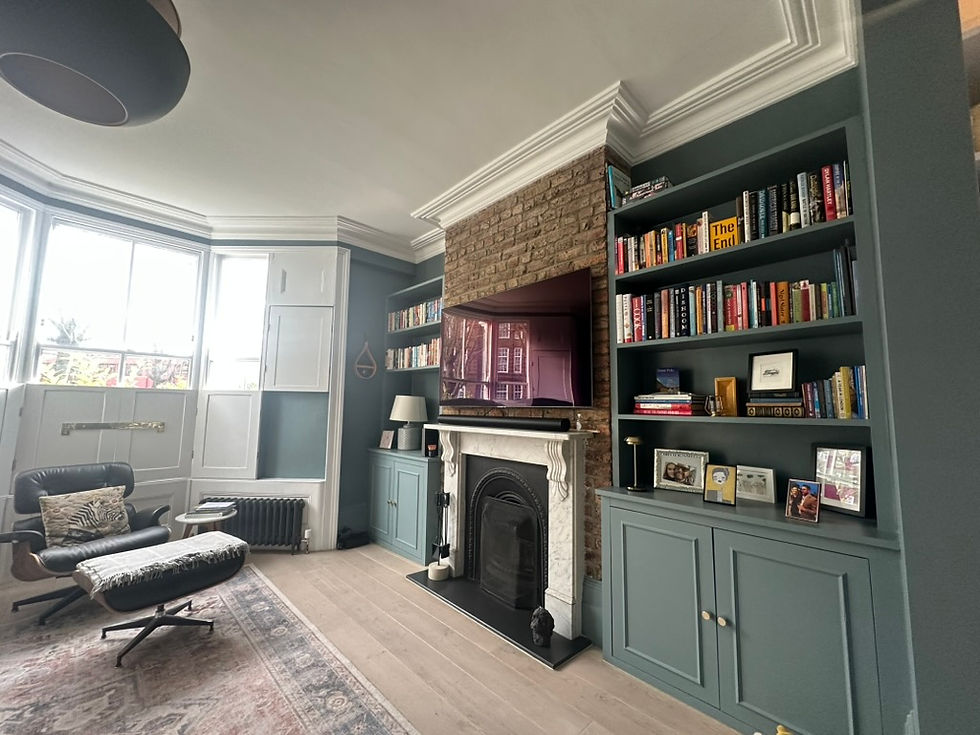
How to tell if your home is Victorian or Edwardian (or something else entirely)


When I visit a period property project for the first time, I ask if the owners know when their house was built. The answer is often no, or only a vague idea. The chances are, they've heard neighbours talking about the era of the property and just assumed that it's correct. It might be, but it's always good to check. And here's how you can do it.
Why do I need to know if my home is Victorian or Edwardian?
It's certainly not essential, but if you're renovating or decorating your home it's helpful to understand the history of the building in order to be sensitive to its features. I don't believe in making period homes into museums, but I do think it's important to preserve original features that are still useful and beautiful, and to understand how the history informs decor decisions. It's also a lovely thing to know the story of your home.
So how do I find out when it was built?
You might be one of those lucky homeowners who has the build date engraved into the front of your house. If so, you have your answer! But many homes don't have this and require more work.

Think of yourself as a detective when it comes to establishing your home's birthday. A good starting point is to wander down your street and to see if any other homes have a date mark. If they do, you can assess whether the style is similar to yours. This may give you a rough idea.
The most accurate way is to look at your deeds (if you own the property). The deeds may tell you when the house was built and who bought it. It may even tell you who built it. As with all legal documents, house deeds that are over 100 years old are often archaic and confusing so you will need to take your time with them. Beware, you may get sucked in and discover all sorts of things about your home (as I did)!
I went back through the deeds of my house when writing this post and have ended up with more questions than answers.

I'd always thought that our house was built in 1909 and I think that is about right, but the latest trawl through the documents has not quite confirmed that. What I do know is that the plot of land which includes my house, our adjoining neighbours' and our two neighbours on the other side was purchased in 1894 because I have the deed of sale. I also know that in 1899 the plot that my house and our adjoining neighbours’ house were built on was bought by the man who lived in my house up until 1920 when he died (I have his will documents). So my house was built sometime between 1899 and 1920. Presumably well before 1920 as he was living there and his sister in the adjoining (our neighbours') house, and not during the war (1914-18). Most likely it was built between 1900-1910 making it Edwardian.
The pack of documents also revealed that my house has a name and is referred to as "Goschen" in many of the conveyancing documents. The adjoining neighbours' home is referred to as "Eversley". A little research tells us that our house was probably named after George Joachim Goschen, 1st Viscount Goschen, who was once Chancellor of the Exchequer. The adjoining house was likely named after George John Shaw-Lefevre (1st Baron Eversley). They were both highly influential figures in late Victorian and Edwardian politics.
Even if you have a pack of information like this, like me, you may not be able to find the exact date that the house was built and for that you may have to visit the local council archives.
I recently asked a question over on Instagram stories about knowing when our homes were built and had an interesting response from one friend:
"We were having trouble finding our house in the censuses in the early 20th century. We had worked on the basis it was probably built around 1900. My dad checked the 1921 census when it was released a few years back and it still wasn’t there. So we applied to look at the council archives for our address. We had to book an appointment and request specific documents from storage. We rolled up on a Saturday afternoon and had a brilliant few hours. We located the original planning application for our house and found it was built in 1922."
I’m interested in doing this for my house because even though we have some information, I'd love to know more about the people who first lived in my house as well as the street and the surrounding area. I'm going to pay a visit to my local library too, as often books written by local people about your area can sometimes contain photos of your street if you look carefully. You become your home's archivist!
You may not have the time or inclination to do the above, but you can look for clues in any original features you might have. I wrote another blog post on the differences between Victorian and Edwardian homes which you can read here.
What counts as Victorian and Edwardian and what if my house doesn't fit those dates?
Victorian refers to houses built from 1837 to 1901
Edwardian refers to houses built from 1901 to around 1910 (though some sources extend it to 1914)
As with my friend on Instagram, a significant number of houses built after WWI retain many Edwardian features, because of course a change of monarch doesn't mean that building styles immediately changed! Homes built in the late 1920s/1930s are likely to have some Art Deco influences: geometric shapes, steel-framed Crittall windows/doors and zigzag, chevron or sunburst motifs to name a few.
Many homes in the UK were built between 1920 and 1939 or the 'interwar period' as it's often known. Where I live on the borders of SW London and Surrey, there are many of these houses. They are more likely to have been built by developers, which may mean there is less historical information, but they will still have their stories!
So, what is your home’s birthday?
Whether yours turns out to be Victorian, Edwardian, interwar or something in between, the date doesn't really matter as much as the story behind it. Knowing roughly when your home was built will help you to decide which features are worth keeping, which colours and materials suit it, and where some sensitivity is required.
Begin with the easy clues: a date stone, the houses next door and your deeds.
If those leave you with more questions than answers, like me, the council archives and your local library might be the next stop. I’ll report back once I’ve discovered more about my house.
In the meantime, I’d love to know what you find. Leave a comment below or send me a message and tell me when your home was built.
Once you know your home’s age, the next question is what to do with it. Helping owners of Victorian and Edwardian homes work with their period features, not against them, is what I do every day. If you’d like a hand, you can find out more about working with me here:
Hannah x