The Period Features Worth Restoring - and When to Recreate Instead

Updated: Jul 27
There’s a decision that comes up in almost every period home project I work on, and it rarely has a simple answer. Do you restore the original feature, or do you recreate it?
The two things sound similar but they’re not.
Restoration means working with what’s there: repairing, consolidating, preserving.
Recreation means starting again, making something new that respects the original.
Both can be the right choice. The mistake is assuming restoration is always more authentic, or that recreation is always a compromise.
Here’s how I think about it.
What makes period features worth caring about?
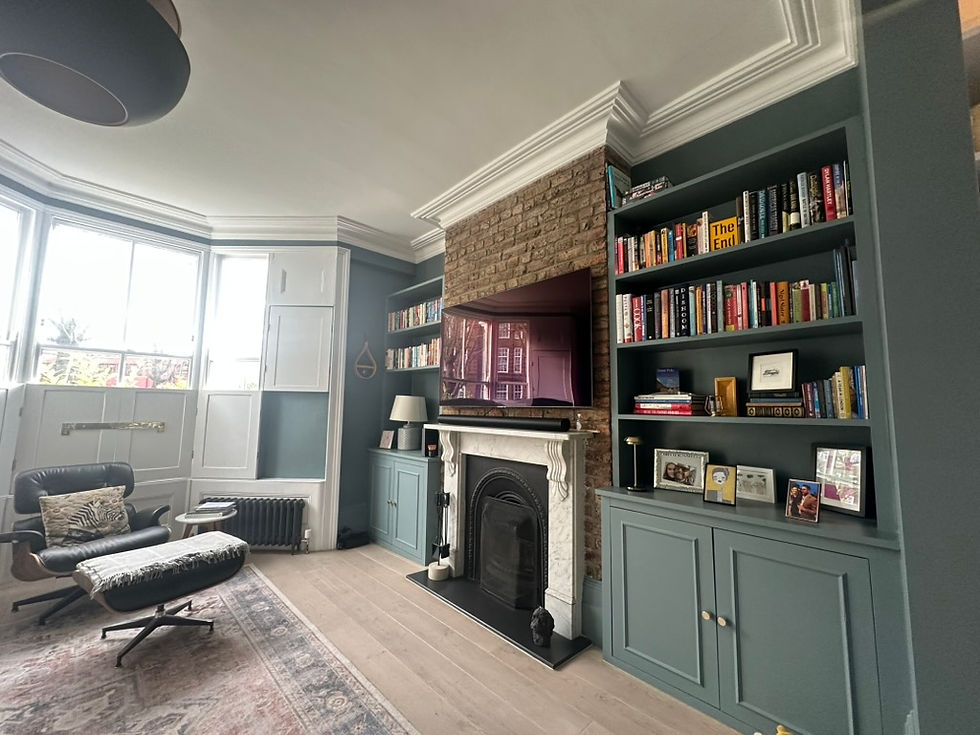
Victorian and Edwardian homes were built at a time when plots of land were bought by developers who might build one or two houses at a time. The buyer often had some say in the fittings - the profile of the cornicing, the depth of the skirting, the detail on the architrave. This is why two houses on the same street can have entirely different moulding profiles, and why even modest terraces often have more considered detailing than you’d expect.
That individuality is part of what makes these homes special. The mouldings, windows, and fireplaces weren’t standard-issue, they were expressions of the household’s taste and means. Grander detailing signalled that the owner was doing well. A more restrained profile might reflect a different budget, or simply a different aesthetic preference.
Sambourne House in Kensington is a vivid reminder of how Victorians actually used these features. The house has been preserved almost exactly as it was in the 1870s and 80s, and it shows just how intentional and layered the original interiors were. The idea that cornicing and skirting should be painted brilliant white is a modern convention - the Victorians almost certainly wouldn’t have done it. They used colour and contrast in ways that felt rich and deliberate. In fact, brilliant white paint was only available after WWII.

All of which is to say: these features carry history, and they reward attention. On a practical level, well-preserved period details also help set a property apart. They’re assets - but like any asset, they need looking after.
When to restore
Restoration is the right call when the original feature is structurally sound and the material is mostly intact. Solid timber, plaster, and stone age well - far better than most modern replacements. If the bones are good, working with what’s there is almost always preferable.
I look at three things when assessing whether a feature is worth restoring:
Structure. Is the core still sound? A fireplace might have significant surface damage but remain structurally intact - very different from a window with a rotten frame beyond saving.
Material integrity. How much of the original is actually there? If you’re repairing 20% of a cornice, that’s restoration. If you’re repairing 80%, you’re essentially rebuilding - at which point recreation becomes the more honest and often more cost-effective route.
Craftsmanship. Original period details are often intricate in ways that are genuinely difficult to replicate. Where that detail is still visible, it’s worth preserving what you can of it.
Cornicing is a good example. In a recent project in a Victorian terrace in Putney, the living room had high ceilings and no cornicing at all - it had been stripped out by a previous owner and replaced with an oversized wall mirror.
The mirror itself had potential, but without the cornice, the proportions felt wrong. I suggested my clients speak to their immediate neighbours and look at the equivalent room - the cornicing was still intact next door, which meant we had something to match from.
We then contacted the London Cornice Company, who offer a bespoke matching service. It’s a project still in progress, but the principle is a useful one: if your home has lost a feature, your neighbours may still have it.
If you're working through a similar decision in your own Victorian or Edwardian home, this is exactly the kind of thing I can help with. Find out how I work with clients here.
Original sash and casement windows are another category where restoration, if feasible, is usually worth it. The bay window in a Victorian project I worked on in Finsbury Park is original and stunning - but single-glazed and draughty. The question for the client was whether to restore or replace. My view is that where replacement is necessary, it should be like-for-like: double-glazed timber, not uPVC, to preserve the character of the opening.
In my own Edwardian house, we had an arch-shaped window that had been fitted with ugly secondary glazing by a previous owner. We made the decision not to replace it with a standard rectangular window - which would have been cheaper and simpler - and instead commissioned a local joiner to make a replica in exactly the same shape, with double glazing. It’s one of the best decisions we made. The arch is the defining feature of that room, and losing it would have changed the whole character of the space.

When to recreate
Recreation makes sense when the original is too far gone, missing entirely, or no longer functional. Done well, it needn’t feel like a compromise - it’s about respecting the original intention while acknowledging what’s practical.
Missing or heavily damaged cornicing. If large sections are gone, patching can make the problem worse. Uneven detail across a ceiling is more distracting than a clean, consistent profile recreated throughout. A well-made replica, properly matched, can be seamless.
Replica fireplaces. Original fireplaces are frequently removed, damaged, or no longer compliant with current safety standards. A period-style replica allows you to reintroduce a focal point that’s appropriate to the room - and one that actually works.
Period-style radiators. Original cast-iron radiators can be beautiful, but they’re not always compatible with modern heating systems. Period-style radiators recreate the aesthetic while meeting the demands of a contemporary home.
The key word in all of this is thoughtful. Recreation that doesn’t reference the original - wrong profile, wrong proportion, wrong material - will look exactly like what it is. The research matters.
On mixing old and new
Period features don’t require a period interior. Some of the most successful projects I’ve worked on have paired original details with contemporary furniture and a restrained palette - and the contrast is exactly what makes them work.
The cornicing becomes a frame. The floorboards become a foundation. The fireplace earns its place without demanding that everything else submit to it.
What doesn’t work is ignoring the features entirely - designing around them as though they’re not there, or worse, treating them as inconvenient. A period home with its details intact is an opportunity. It already has a story. The job of a good interior is to continue that story, not to contradict it.
I specialise in Edwardian and Victorian homes, supporting clients in making considered choices about how best to preserve — or thoughtfully reinterpret — the character of their properties. Take a look at my portfolio, or if you'd like to talk through a project, visit my services page or drop me a line at info@hannahashe.co.uk.